




Home prices, property taxes, commute routes, trails, schools, neighborhood character and resale—here’s what actually changes when buyers compare Brushy Creek with Cedar Park.

If you’re looking north of Austin, Brushy Creek and Cedar Park almost always end up on the same shortlist.
They’re close enough that you can drive from one to the other without feeling like you’ve completely changed parts of town. They share shopping, restaurants, major roads and even portions of the same trail system.
But living in them can feel surprisingly different.
And there’s an important geography lesson before we go any further:
Brushy Creek isn’t a city. It’s a census-designated place in Williamson County, while Cedar Park is an incorporated city. To make matters slightly more confusing, real estate conversations often use “Brushy Creek” more broadly to describe communities along the Brushy Creek corridor—including some properties with Cedar Park addresses. The Ranch at Brushy Creek is a perfect example: it is associated with Brushy Creek while being located in Cedar Park.
So this isn’t really about drawing a line down the map and declaring one side better.
It’s about understanding why a buyer comparing similar homes may ultimately prefer a Brushy Creek location over another part of Cedar Park.
And some of the reasons may surprise you.
Brushy Creek vs. Cedar Park at a Glance
| Brushy Creek | Cedar Park | |
|---|---|---|
| Current median sale price* | About $537K | About $528K |
| Median days on market* | 34 days | 40 days |
| School districts | RRISD or LISD depending on address | LISD or RRISD depending on address |
| Outdoor focus | Neighborhood greenbelts + regional trail connections | Large city parks + regional trails |
| Major commute options | SH 45, RM 620, Parmer, Great Oaks, I-35 access | 183A, US 183, RM 620, Parmer |
| Government structure | CDP/MUD/County | Incorporated city |
| Overall feel | Smaller interconnected residential pockets | Larger suburban city |
*Redfin data for the three-month period ending June 2026. Brushy Creek recorded a median sale price of $537,208 and 34 median days on market; Cedar Park recorded $528,213 and 40 days.
And already we need to bust our first assumption.
1. Brushy Creek Isn't Necessarily Cheaper
This surprised me when I pulled the current numbers.
Over the three months ending June 2026, the median Brushy Creek sale price was approximately $537,000, compared with approximately $528,000 in Cedar Park.
So if someone tells you buyers are choosing Brushy Creek because houses are automatically less expensive?
That's not what the current market-wide numbers show.
The difference is more about what you're getting for the money and where the house sits.
Brushy Creek contains established sections with mature landscaping, smaller homes, larger homes, different lot configurations, greenbelt properties and homes with close trail access.
Cedar Park covers a much larger area with an equally broad range of housing.
And then there are neighborhoods that blur the comparison completely.
Take The Ranch at Brushy Creek. Redfin's three-month median there was roughly $824,000 through June 2026—considerably above both the overall Brushy Creek and Cedar Park medians.
So I wouldn't ask:
“Which area is cheaper?”
I'd ask:
“What can I buy in each location at my specific budget?”
That comparison is much more useful.
2. Property Taxes Are More Complicated Than “Brushy Creek Has Lower Taxes”
This is probably the section I'd save and send to anyone comparing the two.
Because you cannot accurately compare property taxes using Brushy Creek vs. Cedar Park alone.
Brushy Creek MUD and the City of Cedar Park are different taxing entities.
For the 2025 tax year, Brushy Creek MUD's adopted district rate was approximately $0.386837 per $100 of assessment, while Cedar Park's adopted FY2026 city rate was $0.360000 per $100. Some Brushy Creek properties inside a defined area may also have an additional district assessment.
Then add the school district.
Round Rock ISD's 2025 total rate was $0.8931 per $100, while Leander ISD's 2025–26 rate was $1.0869 per $100. Both school districts can appear in this part of Williamson County, and Cedar Park's own GIS recognizes both RRISD and LISD boundaries.
Then you still have county and potentially other taxing jurisdictions.
The takeaway?
Never compare taxes by neighborhood name. Compare the exact addresses.
Two houses with nearly identical prices can have noticeably different annual tax bills because they sit inside different combinations of jurisdictions.
As of September 1, 2026, the next round of rates is also still moving through local budget processes. Brushy Creek MUD established proposed 2026 district rates totaling $0.407 per $100 before any defined-area assessment, while Cedar Park set a proposed maximum FY2027 city rate of $0.377930 pending its remaining budget process.
This is one comparison I'd redo for the individual property every single time.
3. The Commute Question Depends on Where You're Going
I wouldn't tell a buyer that Brushy Creek has a “better commute.”
Better commute to what?
That's the question.
Brushy Creek's position can make it attractive to someone moving frequently between Round Rock, SH 45, Parmer Lane and the I-35 side of the metro.
Cedar Park's western position gives drivers direct access to the 183/183A corridor, which is a major advantage if your routine takes you south through Northwest Austin or north toward Leander.
The 183A Toll Road runs nearly 16 miles from RM 620 through Cedar Park and Leander, and the Mobility Authority specifically designed it as an alternative to congestion along US 183.
That means I wouldn't use generic commute estimates in a home search.
I'd pull up the house and test:
House → office at 8 a.m.
Office → house at 5 p.m.
House → airport.
House → places you visit every week.
Five miles closer on a map does not always mean five minutes faster in Central Texas.
4. Brushy Creek's Trail Access Is Hard to Ignore
Here's where Brushy Creek starts making a particularly strong case.
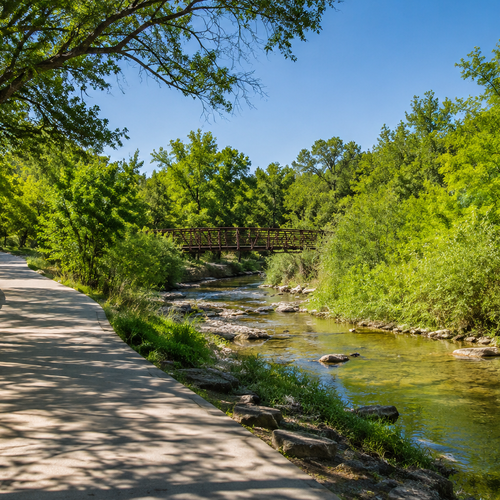
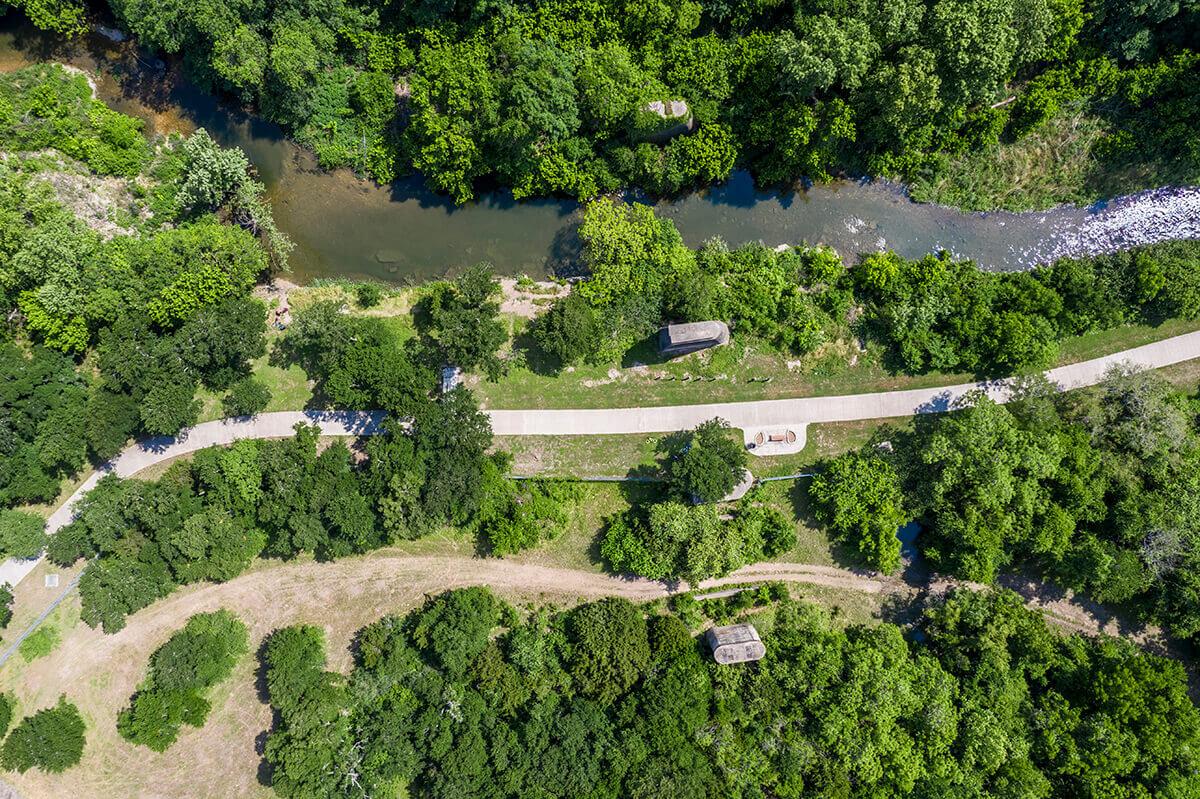
The Brushy Creek Regional Trail is approximately 7.75 miles and mostly concrete. More than six continuous miles run from just west of Great Oaks Drive along Brushy Creek to Twin Lakes Park in Cedar Park. The route connects parks, residential areas, retail and open spaces.
But the regional trail is only part of it.
Brushy Creek MUD maintains its own network of neighborhood greenbelts and trails, including the Community Park Greenbelt, Sendero Springs Greenbelt, Wildcat Trail, Woods Greenbelt/Ephraim Trail and Creekside connection.
That's where the difference can become very property-specific.
A house may be a few streets from a greenbelt entrance.
Another may back toward the trail.
Another might require loading the bikes into the car.
That is why I've become a little obsessive about asking:
“Can we actually walk to the trail from this house?”
instead of accepting “near Brushy Creek Trail” in the listing remarks.
5. But Cedar Park Is Absolutely Not Losing the Outdoor-Amenity Contest
This needs to be said because otherwise the comparison becomes unfair.
Cedar Park maintains more than 1,000 acres of parkland and more than 40 parks, along with pools, a splash pad, sports facilities and preserved natural areas.
Then there's Lakeline Park.
The first phase includes a lake loop, wide concrete trails, kayak access, fishing, playgrounds, fields, a large lawn and wildflower areas.
And Brushy Creek Lake Park is actually in Cedar Park.
The 90-acre park includes a 38-acre lake, hike-and-bike trails, a nature trail, playgrounds, fishing, a canoe/kayak launch and splash pad.
So the difference isn't:
Brushy Creek = outdoors. Cedar Park = no outdoors.
Not remotely.
It's more like:
Brushy Creek: recreation can feel woven directly through individual residential pockets.
Cedar Park: you get a larger citywide park system with several major destination parks.
Which experience appeals more depends on the house you're comparing.
6. Brushy Creek Can Feel More Like a Collection of Neighborhoods Than a City
This might be the hardest difference to describe in a spreadsheet.
Cedar Park is a city.
You have city government, commercial corridors, large retail centers, major roads, municipal parks, a public library and recreation facilities spread across the community.
Brushy Creek is different.
The Census Bureau classifies Brushy Creek as a CDP rather than an incorporated municipality. Much of the daily community infrastructure is tied to Brushy Creek MUD, which operates neighborhood parks, greenbelts, pools, sports facilities, programs and the Brushy Creek Community Center.
That can create a more neighborhood-centered experience.
Cat Hollow Park.
Sendero Springs Pool.
Brushy Creek North Park.
Little Village Park.
Racine Woods Park.
Creekside.
Community Park.
They aren't all giant destination parks. Many sit directly inside residential sections.
And that is exactly what some buyers respond to.
Not “better.”
Just different.
7. Schools Don't Give Either Area an Automatic Win
Another assumption I'd throw out immediately:
“Brushy Creek means Round Rock ISD and Cedar Park means Leander ISD.”
Nope.
Brushy Creek Elementary is an RRISD campus right inside the Brushy Creek area. Cox Elementary sits directly on Brushy Creek Road in Cedar Park and belongs to LISD.
And Cedar Park's municipal school-district mapping includes both Leander ISD and Round Rock ISD territory.
This is one reason I'd never choose a neighborhood from the school district label alone.
Verify the exact address.
Then verify:
Elementary → Middle → High School
directly with the district.
Both districts also have transfer and specialized-program options that can change over time, so the assignment attached to today's real estate listing shouldn't be treated as permanent.
8. The Resale Numbers Are Interesting Right Now
This is one of the current statistics that caught my eye.
During the three months ending June 2026:
Brushy Creek
Median sale price: $537,208
Year-over-year price change: +2.3%
Median days on market: 34
June sales: 68
Cedar Park
Median sale price: $528,213
Year-over-year price change: +1.1%
Median days on market: 40
June sales: 272
At first glance, that makes Brushy Creek look slightly stronger.
But I would not turn that into:
“Brushy Creek has better resale.”
The Cedar Park dataset is much larger. These are short-term market statistics, and neighborhood-level performance can move differently from the city or CDP median.
What it does tell me is that Brushy Creek isn't currently behaving like some obscure secondary market buyers overlook.
Homes there are moving.
And the combination of established residential areas, trail connections, greenbelt lots and location can give a well-positioned property features that stand apart when it's eventually time to sell.
9. Some Buyers Want the Middle Ground
I think this may be the biggest reason Brushy Creek keeps showing up in searches.
It occupies an interesting middle ground.
You can be close to Cedar Park without feeling like you're deep into Cedar Park.
You can be close to Round Rock without necessarily being inside the city.
You can reach major retail and highways while still having neighborhood parks, mature trees and trails nearby.
And depending on the exact street, you can find a home that feels surprisingly removed from how developed the surrounding metro has become.
That's difficult to communicate with one statistic.
But buyers feel it when they're touring.
So...Brushy Creek or Cedar Park?
I wouldn't pick one before seeing the houses.
That's the whole point.
Choose Brushy Creek because you found a particular combination of location, lot, trail access, neighborhood setting, price and tax structure that makes sense.
Choose Cedar Park because its city amenities, parks, housing options, 183A access and particular property make more sense.
And don't be surprised if the answer changes within a five-minute drive.
Because these areas are close enough that the individual house can matter more than the name on the map.
The Comparison I'd Actually Make
If I had two homes sitting in front of me—one in Brushy Creek and one elsewhere in Cedar Park—I'd compare:
Purchase price → actual annual taxes → commute route → school assignment → HOA/MUD → trail and park access → street traffic → lot position → current competition → recent comparable sales.
Then I'd ask the simplest question:
Which house works better for the life you're actually planning to live?
That's a much smarter way to decide than beginning with:
“Brushy Creek or Cedar Park—which one is better?”
Thinking About Brushy Creek or Cedar Park?
At Hoyden Homes, we can help you compare the things that aren't obvious from a portal search—the street, lot, current competition, tax jurisdictions, trail access, commute routes and how similar homes have actually performed.
Because when two homes are ten minutes apart, the differences can look small on a map.
They may feel considerably bigger once you live there.
Check out this article next