





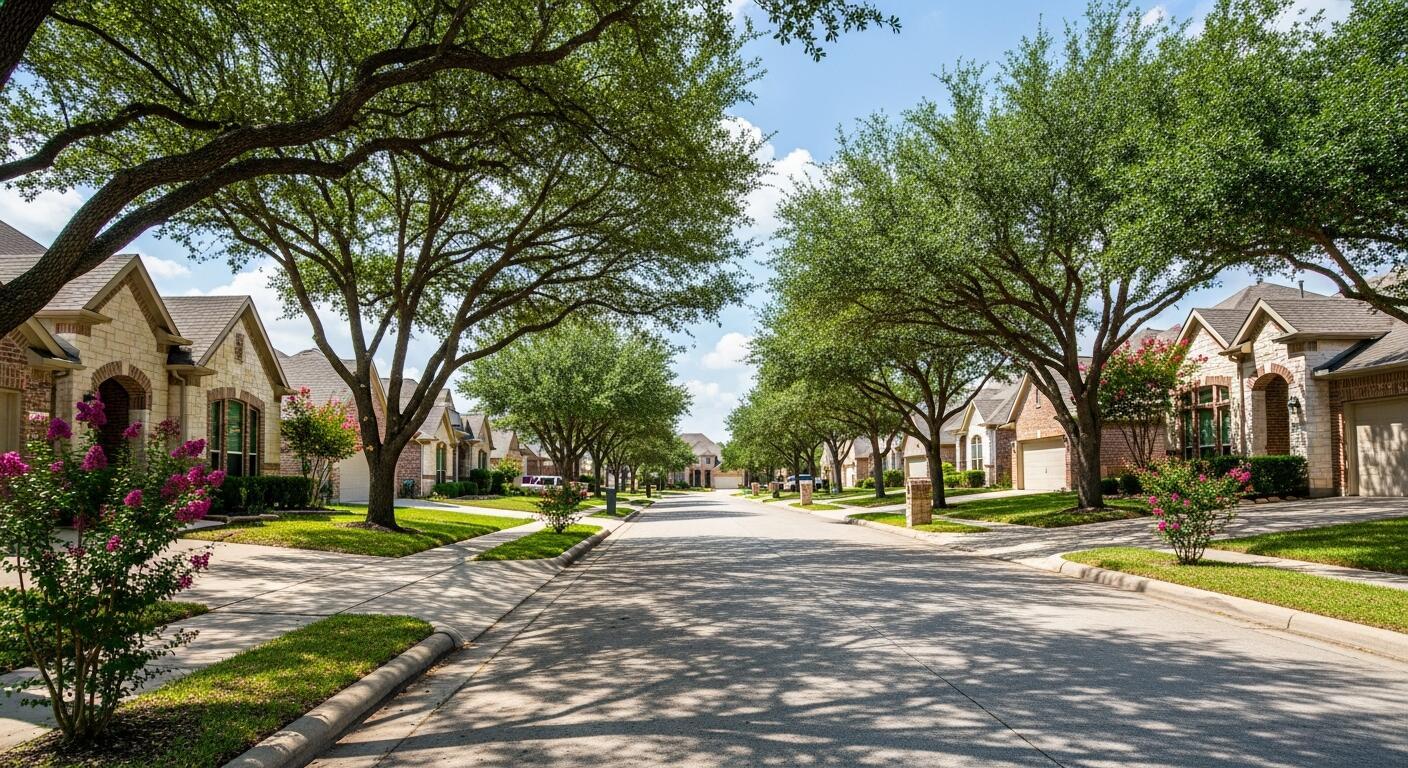
Forget the neighborhood for a minute. In Brushy Creek, the street can completely change the experience.
When buyers search for homes in Brushy Creek, they usually start with neighborhood names: Cat Hollow, Woods of Brushy Creek, Brushy Creek North, Sendero Springs, Village of Brushy Creek.
That's a good starting point.
But it's not where I'd stop.
Spend enough time driving through Brushy Creek and you'll notice that two homes in the same general area can feel completely different.
One might sit beneath mature oak trees on a short interior street. Another could be close enough to walk to a trail entrance. One may back toward green space, while another sits directly on a road that carries traffic through the neighborhood.
And then there are those little streets and pockets you might completely miss if you're only searching by subdivision.
So we're zooming in.
These are some of the actual Brushy Creek streets and pockets I'd pay attention to when a home hits the market—plus what I'd look for on each one.
Before We Start: What Makes One Brushy Creek Street Stand Out?
Brushy Creek's parks and trail network are unusually woven into its residential areas. Brushy Creek MUD maintains numerous parks, greenbelts and neighborhood trails, while Williamson County's Brushy Creek Regional Trail runs for roughly 7.75 miles, with more than six miles extending from just west of Great Oaks Drive toward Twin Lakes Park in Cedar Park.
That means I'd look beyond countertops and square footage when comparing two Brushy Creek homes.
I'd also pay attention to:
Mature trees: Not every section has the same tree canopy.
Through traffic: Is the home directly on one of the roads people use to move across Brushy Creek, or is it tucked a turn or two away?
Trail access: There's a big difference between living "near" Brushy Creek Regional Trail and being able to walk out your door and reach a trail connection.
Street shape: Loops, shorter interior streets and cul-de-sacs can create a different setting than long connecting roads.
Lot position: Interior lot, greenbelt-facing, creek-adjacent, backing to another home or backing toward a road?
Sidewalk access: If walking or biking is important to you, actually walk the route instead of assuming the map tells the whole story.
Creek proximity: Beautiful? Absolutely. But creek-adjacent property deserves additional due diligence on drainage, flood mapping and insurance.
Now let's drive the streets.
1. Great Oaks Drive — But Here's the Trick
Great Oaks Drive might be the most important road to understand if you're trying to learn Brushy Creek.
It runs through the heart of the area and puts you near parks, the Brushy Creek Community Center, trails and established residential sections.
And the tree canopy isn't just something locals notice. Brushy Creek MUD recently completed planning work specifically focused on preserving and protecting the tree canopy along portions of the Great Oaks median.
So yes, Great Oaks belongs on this list.
But I wouldn't necessarily tell every buyer to purchase a house directly on Great Oaks.
The insider move?
Look at the smaller residential streets branching off it.
Great Oaks functions as an important connector through Brushy Creek. It also intersects roads including O'Connor Drive, Brushy Creek Road, Sendero Springs Drive and Sam Bass Road. Brushy Creek MUD even maintains a 0.9-mile trail through part of the Great Oaks median between Sendero Springs Road and near Sam Bass Road.
So if you love the trees and central location but want less direct through traffic, explore the streets immediately off Great Oaks instead of limiting your search to Great Oaks addresses.
What I'd look for nearby:
- Mature tree coverage
- Interior lots
- Shorter residential streets
- Convenient trail connections
- Walking distance to the Community Center or nearby parks
What I'd investigate:
Traffic at the particular lot during morning and evening drive times.
2. Park Drive + The Streets Around Brushy Creek North Park
This is one of those areas where I'd tell a buyer:
Slow down and drive around instead of just heading to the next listing.
Brushy Creek North Park is located at 4000 Park Drive, and Brushy Creek MUD identifies the park as part of its larger park and trail system. The park includes recreation fields, a playscape and a neighborhood trail.
Park Drive and the surrounding residential streets have something I like in a home search: a neighborhood amenity sitting inside the residential fabric instead of requiring a drive across town.
BCMUD has even directed visitors to use both Park Drive and Hill Top Drive for overflow street parking during past park events, confirming just how integrated these streets are with the park itself.
Why I'd explore this pocket:
You have established residential streets surrounding a neighborhood park rather than a large commercial corridor.
If trail access matters to you, this pocket deserves an in-person visit.
What I'd look for:
- Homes within a comfortable walk of the park
- Short interior streets around Park Drive
- Cul-de-sac opportunities nearby
- Mature landscaping
- Lots positioned away from heavier connector roads
One 2026 note: Brushy Creek MUD currently has a sanitary sewer capacity project affecting the Brushy Creek North area, with construction anticipated to begin in 2026. Buyers considering a property along the project route should check current construction updates.
That's exactly the type of thing you won't learn from staring at listing photos.
3. Whitebrush Loop — One of the Little Pockets I'd Definitely Drive
Whitebrush Loop is a street I would put on the scouting list.
Why?
Little Village Park sits directly on Whitebrush Loop in the Village of Brushy Creek. Brushy Creek MUD describes it as a two-acre pocket park with a trail and abundant shade trees, including a recognizable bent Live Oak.
That immediately gives this pocket something different from a street where your nearest recreation space is several turns away.
What makes Whitebrush Loop interesting:
It's quite literally wrapped around a neighborhood pocket park.
If being able to step outside and easily access green space matters to you, that's worth seeing in person.
What I'd look for:
- Which homes have the easiest park access
- Mature tree placement on individual lots
- Sidewalk configuration
- Homes facing versus backing toward park/open-space areas
- How much activity the park creates at different times of day
This is also a good example of why I don't like declaring an entire neighborhood "better" than another.
A house positioned well on Whitebrush Loop can provide a completely different daily experience than another house only a few blocks away.
4. Racine Trail — Woods of Brushy Creek
Here's another one buyers might overlook.
Racine Trail runs through the Woods of Brushy Creek, and Brushy Creek MUD's Racine Woods Park is located directly at 8174 Racine Trail.
The MUD describes this small pocket park as a natural setting with large rocks and numerous tall trees.
That's why this street catches my attention.
It isn't about having the largest community amenity.
It's about having a small wooded pocket built directly into the residential area.
What I'd look for on Racine Trail:
- Mature tree canopy
- Lots near—not necessarily directly beside—the pocket park
- Interior positioning
- Nearby trail connections
- How the lot sits relative to neighboring homes
If you're someone who tells me, "I don't want everything to feel completely uniform," this is the type of street I'd want you to at least drive.
Not because every house on Racine Trail will fit.
But because the setting deserves a look.
5. O'Connor Drive + The Interior Cat Hollow Streets
Cat Hollow is one of the best-known names in Brushy Creek, but there's a big difference between saying:
"I want Cat Hollow."
and saying:
"I know which part of Cat Hollow I prefer."
Cat Hollow Park is located directly on O'Connor Drive, and Brushy Creek MUD's trail network extends through this portion of the community. Its Community Park Greenbelt runs through Cat Hollow and can terminate at O'Connor Drive, Liberty Walk Drive or Great Oaks Drive depending on the path taken.
That gives buyers a lot to explore.
But here's my distinction:
O'Connor is the landmark. The interior streets are where I'd start hunting.
O'Connor is a significant neighborhood connector. Williamson County has installed traffic signals at intersections including Liberty Walk, Great Oaks Drive and Morgan Hill Trail, another clue that this isn't simply a little residential side road.
So if someone tells me they want Cat Hollow because they love the park and trails, I'd start looking at the streets branching off O'Connor and Liberty Walk, not automatically for a house directly on the main road.
What I'd look for:
- Shorter interior streets
- Cul-de-sacs
- Walking connections to Cat Hollow Park
- Access to the Community Park Greenbelt
- Mature trees
- Lot orientation
6. Liberty Walk Drive — A Trail Connection Buyers May Miss
Liberty Walk deserves its own mention because it isn't just another road through Cat Hollow.
One branch of the Community Park Greenbelt actually ends at Liberty Walk west of O'Connor Drive, creating a direct connection into Brushy Creek's trail system.
Brushy Creek MUD has also developed a Monarch butterfly demonstration garden along Liberty Walk in partnership with the Cat Hollow HOA.
So while I'd still consider traffic and the individual lot carefully, this is one of those streets where understanding the surrounding pedestrian and greenbelt connections can change how you look at a listing.
My advice:
Don't just drive the house.
Park the car and walk the area.
Find the actual trail entrance.
See where it goes.
See whether you'd realistically use it.
That tells you far more than a listing description saying "close to trails."
7. Pasada Lane + Sendero Springs
Sendero Springs gives us another street-level example.
Sendero Springs Park & Pool is located at 4203 Pasada Lane, with open fields, trails, a playground and a swimming pool.
Even more interesting: the Wildcat Trail begins across the street from Sendero Springs Park & Pool, runs roughly 1.44 miles through the area, passes through Brushy Creek North Park and eventually reaches the area near the Brushy Creek MUD Water Treatment Facility on Great Oaks Drive.
That's a meaningful trail connection.
What I'd look for around Pasada Lane:
- Walking distance to the park and pool
- Access to Wildcat Trail
- Interior streets branching from the park area
- Lots that don't directly front a higher-traffic connector
- Cul-de-sac and loop streets nearby
This is another place where I'd physically test the walk from a house to the trail.
Five minutes on foot can tell you whether "trail access" is something you'll actually use or something that simply sounds good in a listing.
8. Hairy Man Road + The Creekside Pocket
Okay, now we're getting into peak Brushy Creek.
Creekside Park sits at 4300 Brushy Creek Road along Hairy Man Road, directly beside Brushy Creek and the Williamson County Regional Trail System. The park includes large pecan and walnut trees, trails and a regional trailhead.
The nearby Shirley McDonald Park at Great Oaks and Brushy Creek Road also sits directly on the regional trail system.
If what you picture when you hear Brushy Creek is trees, water and trail access, this corridor explains why.
But here's where I'd be particularly careful.
Creek-adjacent and creek-nearby are not interchangeable.
The setting can be fantastic, but proximity to waterways means I'd want buyers to investigate the specific property's drainage, elevation, survey and current flood designation before getting emotionally attached.
Use the official FEMA Flood Map Service Center to research the individual property rather than assuming the risk based on the neighborhood as a whole.
This is one of those situations where one lot can be very different from the next.
So...What About Cul-de-Sacs?
Yes.
If a buyer specifically tells me they want less through traffic, cul-de-sacs immediately become part of the search.
But I wouldn't create a universal list of "the best Brushy Creek cul-de-sacs."
Why?
Because the actual lot still matters.
The house at the entrance of a cul-de-sac may have a very different setting from the house at the back.
One could have a larger pie-shaped lot.
Another might back toward a road, utility area or drainage feature.
Another could have exactly the mature trees you're hoping to find.
So instead of searching only by subdivision, I'd look at the map around:
Park Drive
Whitebrush Loop
Racine Trail
Liberty Walk Drive
O'Connor Drive
Pasada Lane
Great Oaks Drive
Then zoom in.
Look for the shorter residential streets, loops and cul-de-sacs branching from those anchors.
That's where things get interesting.
The Street Test I Wish More Buyers Did
Before you make an offer on a Brushy Creek home, come back without your Realtor rushing you to the next showing.
Seriously.
Park the car.
Walk the block.
Then ask yourself:
Can I actually walk to the trail?
How much traffic is passing the house?
What does the street feel like at 5:30 p.m. instead of 11:00 a.m.?
Where do the sidewalks end?
What does the property back to?
Are the mature trees actually on this lot—or just elsewhere on the street?
Is the creek close enough that I need to investigate flood exposure?
How far is the park when I actually walk it?
Those answers can matter a lot more to your everyday experience than whether one house has slightly prettier countertops.
The Real Secret to Buying in Brushy Creek
There isn't one "best street."
And that's kind of the point.
Brushy Creek has established streets, mature trees, pocket parks, larger community parks, neighborhood greenbelts and an extensive trail network scattered throughout different sections of the area. Brushy Creek MUD currently maintains parks ranging from tiny neighborhood spaces like Racine Woods to larger facilities such as Cat Hollow Park, Sendero Springs Park and the Community Center complex.
The trick is matching the street to the way you actually want to live.
Want easy trail access?
Let's look near the trail connections.
Want to avoid living directly on a connector road?
Let's move a couple turns into the neighborhood.
Want mature trees?
Let's drive the established pockets instead of assuming every part of Brushy Creek looks the same.
Want a cul-de-sac?
We'll search for one—but we'll still evaluate the individual lot.
That's the difference between simply finding a house in Brushy Creek...
and understanding where in Brushy Creek you actually want to be.
Thinking About Moving to Brushy Creek?
At Hoyden Homes, we don't just help buyers compare houses.
We help you understand how the location changes from street to street—because sometimes the home that makes the most sense isn't in a completely different neighborhood.
It's right around the corner.
Check out this article next