




Privacy, views, wildlife, mosquitoes, maintenance and resale—here’s what buyers should know before paying more for a greenbelt lot in Brushy Creek.
There's a phrase in real estate that can make buyers stop scrolling almost immediately:
“Backs to greenbelt.”
No house directly behind you. Mature trees. Maybe a trail nearby. Maybe a creek. Maybe morning coffee on the patio with nothing but greenery beyond the fence.
Sounds pretty great.
And sometimes it absolutely is.
But after looking at enough greenbelt homes, you start realizing that not every greenbelt lot offers the same experience.
One may back to dense trees with very little activity.
Another may have a public trail twenty feet behind the fence.
Another may overlook a drainage easement that is gorgeous most of the year but looks completely different after heavy rain.
And another might have the perfect wooded view...along with mosquitoes, deer, snakes, falling branches and a backyard fence that suddenly feels much more important.
So before you automatically pay more because a listing says “greenbelt lot,” let's talk about what you're actually buying.
First: What Does “Backs to Greenbelt” Actually Mean?
This is the first question I would ask.
Because greenbelt can describe several different things.
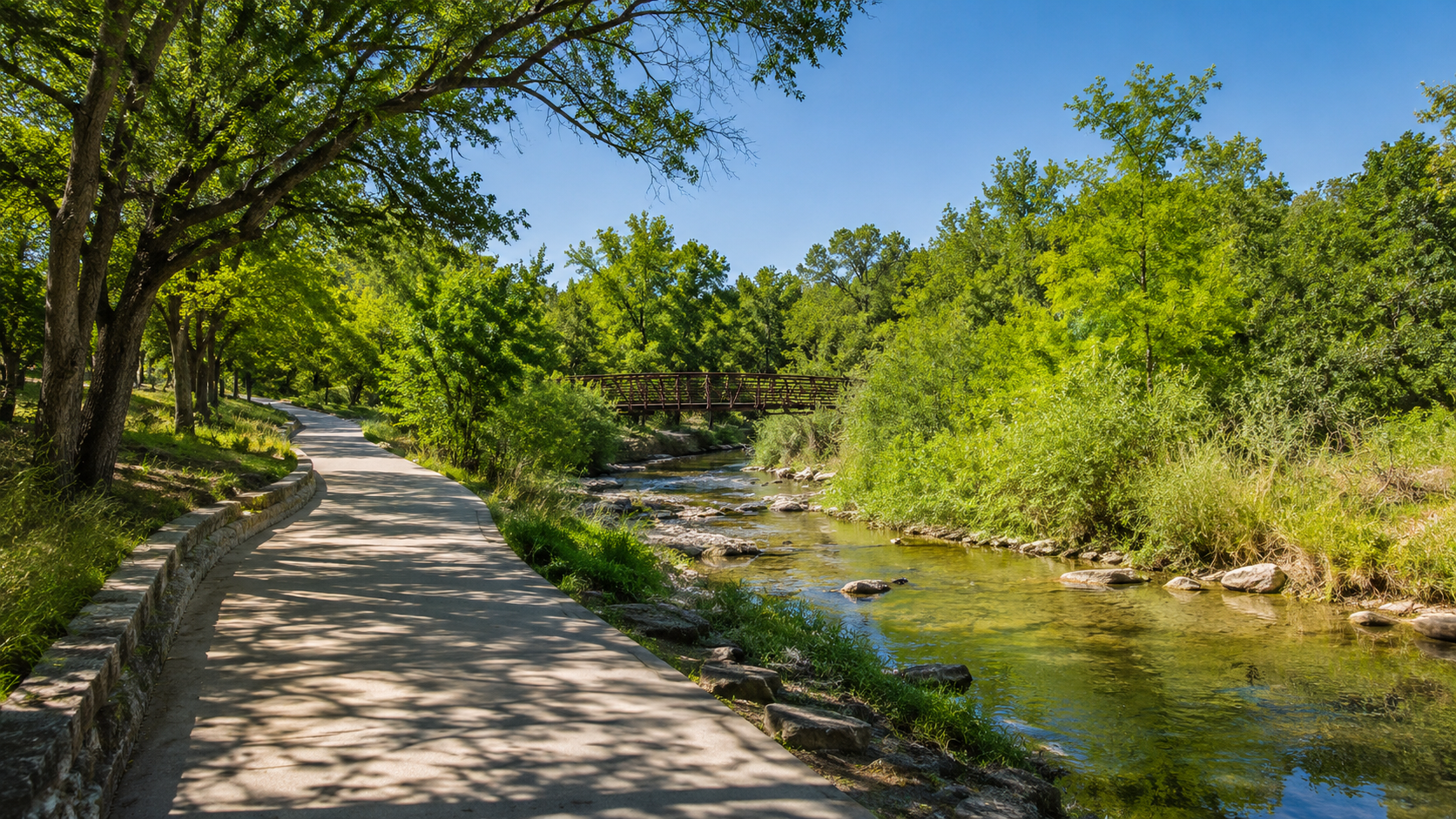
In Brushy Creek, the open space behind a home could be part of a Brushy Creek MUD greenbelt, a public trail corridor, drainage or utility easement, creek corridor, detention area, preserved open space or another parcel entirely.
Brushy Creek MUD maintains an extensive network of trails and greenbelts, including the Community Park Greenbelt, Sendero Springs Greenbelt, Woods Greenbelt/Ephraim Trail and other open-space areas throughout the community.
That's why the view from the backyard isn't enough.
You need to know what that land actually is.
Privacy: This Is Usually the Big Attraction
Let's start with the obvious.
A greenbelt lot can eliminate one of the most common suburban backyard situations:
another house staring directly back at you.
Instead, you may look toward trees, vegetation or open space.
That can make a backyard feel larger and more separated even though the actual property dimensions haven't changed.
But there's an important catch.
Greenbelt does not automatically mean private.
Brushy Creek MUD's public greenbelts are generally open to the public. Current district rules allow use from 5 a.m. to 11 p.m. during spring and summer and 6 a.m. to 11 p.m. during fall and winter.
So if a trail runs behind your property, your backyard may have no neighboring house...
…but it may have walkers, runners, cyclists and dog walkers.
That's a completely different type of privacy.
When I'm evaluating one of these lots, I want to physically find the trail and look back at the house from it.
Can you see the patio?
Can you see directly into upstairs windows?
How far is the trail from the fence?
Is there twenty feet of vegetation between them—or almost none?
A wooded buffer can make a trail feel surprisingly removed.
A path running directly behind a fence can feel very different.
Greenbelt Lot vs. Trail Lot: Know the Difference
This distinction matters enough that I wouldn't lump them together.
A home can back to green space without backing directly to a trail.
For some buyers, that's actually the sweet spot.
You get trees and separation behind the house without regular pedestrian traffic passing the backyard.
A trail-adjacent home offers something different: immediate recreational access.
Neither one is automatically better.
The question is which tradeoff matters more to you:
maximum separation or maximum access?
Then There Are the Views
This is where greenbelt lots can really shine.
Instead of looking at fences, rooftops and another row of houses, you may get:
Trees.
Seasonal wildflowers.
Open sky.
Creek vegetation.
Birds.
Deer wandering through.
And one of the biggest differences is that the view changes throughout the year.
Brushy Creek MUD describes areas such as Woods Greenbelt as having cedar and live oak trees, seasonal bluebonnets and a creek that fills during rainy periods.
That can make the backyard feel much more connected to the surrounding landscape.
But don't assume today's view is permanent.
Vegetation grows.
Trees fall.
Maintenance happens.
Brushy Creek MUD is currently conducting vegetation clearing through portions of trails, greenbelts and drainage easements to improve stormwater flow and reduce obstructions. That 2026 work includes removing overgrowth, invasive vegetation and debris.
So if you're buying the house because of one exact wall of vegetation, understand what property you own and what vegetation belongs to the public space behind you.
The Wildlife Is Real
If you like seeing wildlife from the patio, this can be one of the fun parts.
Brushy Creek MUD specifically reports wildlife in its parks and greenbelts including white-tailed deer, raccoons, coyotes, opossums and multiple species of snakes.
Its Woods Greenbelt information gets even more specific, reporting cottontail rabbits, jackrabbits, rattlesnakes, rough earth snakes, fence lizards, anoles, Mexican free-tailed bats, squirrels and deer along that particular corridor.
So yes, you might look out the window and see a deer.
You may also look out the window and see something you'd rather admire from inside.
That's part of backing to natural space.

Photo credit: G. Lamar / Wikimedia Commons / CC BY 2.0
Greenbelts and creek corridors provide habitat as well as open space, so wildlife sightings are part of living beside Brushy Creek's natural areas.
Okay. Let's Talk About Mosquitoes.
Because somebody has to.
Does backing to a greenbelt automatically mean your backyard will be overrun with mosquitoes?
No.
Mosquito breeding is much more closely associated with standing water and suitable habitat than simply having trees behind the fence.
Texas A&M identifies standing water in containers, gutters, low areas, ponds and other places where water collects as important mosquito breeding sources. Dense vegetation and tall grass can also provide places for adult mosquitoes to rest.
That means two greenbelt homes can have very different mosquito experiences.
A dry, elevated wooded buffer isn't the same thing as a property near seasonal standing water, a drainage area or a slow-moving creek section.
And this isn't merely theoretical locally. Williamson County's current 2026 public-health reporting says mosquito pools continue to test positive for West Nile virus and recommends draining standing water weekly and using appropriate protection from bites.
So when touring a greenbelt property, I'd look beyond the trees.
Look for where water goes after it rains.
That's the more useful question.
Maintenance: Who Takes Care of All Those Trees?
This one can be confusing.
If the open space behind the house is Brushy Creek MUD property, the district contracts for landscape maintenance of its parks, trails and greenbelts. That work includes mowing and other vegetation management in district-maintained areas.
But that does not mean someone else takes care of everything visible from your backyard.
You'll still need to determine:
Where does your property line end?
Which trees are actually on your lot?
Who owns the rear fence?
Is there an easement?
Can you install improvements near that easement?
Brushy Creek MUD has specific standards governing improvements that cross or interfere with district easements and encourages landowners to coordinate before constructing within those areas.
Translation:
Don't assume the land beyond your fence—or even every strip near it—is yours to landscape however you want.
Check the survey.
Check HOA documents.
Identify easements.
Understand the property boundary.
And Greenbelts Can Be Messier Than a Fence Line
Nature is not particularly interested in keeping your patio clean.
Depending on the vegetation, greenbelt-adjacent homes may deal with more:
Leaves.
Pollen.
Acorns.
Branches.
Seeds.
Insects.
Vegetation growing toward fences.
And occasionally larger limbs falling during storms or freezes.
That's not necessarily a reason to avoid the lot.
It just means “low-maintenance wooded view” can be a bit of an oxymoron.
You get the trees.
You also get tree stuff.
Don't Forget Drainage
This is one I would add to every greenbelt conversation.
Some green spaces also serve a practical drainage function.
Brushy Creek MUD's current vegetation project specifically includes drainage easements and detention areas, with work intended to improve stormwater movement and reduce flood risk during heavy rainfall.
So if the land behind a prospective home dips substantially, contains a channel, includes drainage structures or heads toward Brushy Creek itself, investigate it.
That doesn't automatically make the property problematic.
It means you need to understand what happens there when Central Texas gets several inches of rain instead of judging it during a dry August showing.
What About Resale?
This is where I want to be particularly careful.
You'll sometimes hear someone say:
“Greenbelt lots are always worth X% more.”
I would not use that rule.
Research in Austin found that being directly adjacent to a greenbelt was associated with higher sale prices in two of three neighborhoods studied. Direct physical access produced a positive pricing effect in one area but wasn't statistically meaningful in the other two. Importantly, the researchers did not find a negative greenway pricing effect in the neighborhoods they analyzed.
Broader research examining 22 studies of nearby parks and open space also found that increased greenery was frequently associated with stronger home pricing, particularly when the open space was close to the property and permanently protected.
More recent Texas research has also found that greater tree canopy can correspond with stronger resale pricing in many market segments.
But here's the important part:
None of those studies tells us what a buyer should pay for one particular Brushy Creek house.
For that, I want actual comparable sales.
How I Would Price a Greenbelt Lot
I wouldn't simply take the neighborhood price per square foot and tack on a random premium.
I'd compare the subject home against similar recent sales and separate them as much as possible by lot type.
Did greenbelt homes sell faster?
Did buyers consistently pay more?
Were those homes also more updated?
Did they have larger lots?
Did they back to quiet open space or a public trail?
Was the view heavily wooded or mostly drainage area?
And—this matters—what was happening with inventory when those homes sold?
Buyer response is the evidence I care about.
A greenbelt lot can absolutely differentiate a house.
But the market gets to decide how much.
There Is Such a Thing as Too Close to the Action
This is another reason I don't automatically prefer the house directly against the greenbelt.
Sometimes the ideal property is one or two homes away.
You can walk to the trail.
You still get nearby greenery.
You may hear the birds and see wildlife.
But the public path isn't directly behind the patio.
For another buyer, opening the back gate and immediately reaching the trail may be the entire reason they're interested.
That's why I think greenbelt lots are much more personal than MLS remarks make them sound.
My Greenbelt Test Before Buying
Before paying extra for the lot, I would do these eight things:
- Find the property line. Review the survey and determine exactly where private property ends.
- Identify what's behind the house. Public greenbelt? Trail? Creek? Drainage easement? Detention area? Another parcel?
- Walk behind the property. If there's public access, stand on the trail and look toward the backyard.
- Visit after rain if possible. See where water actually moves and collects.
- Come back at different times. A trail at Tuesday noon can feel different from Saturday morning.
- Check easements and HOA restrictions. Especially before planning fences, landscaping or other improvements.
- Inspect the trees and rear fence carefully. Mature vegetation is beautiful, but know what maintenance may eventually be yours.
- Compare actual greenbelt sales. Don't pay a premium simply because someone tells you greenbelt homes “always sell for more.”
So...Are Greenbelt Homes Worth It?
For the right buyer?
Absolutely.
A well-positioned greenbelt home can give you something that is difficult to recreate later:
No immediate house behind you.
Mature trees.
A changing natural view.
Wildlife.
Trail access in some locations.
And a backyard that can feel much more removed from the surrounding neighborhood.
But you're making a trade.
Trees come with debris.
Nature comes with wildlife.
Green space may come with mosquitoes.
A public trail may reduce some of the privacy you expected.
And a drainage or creek-adjacent area deserves considerably more investigation than a listing description can provide.
That's why I wouldn't ask:
“Is a greenbelt lot worth more?”
I'd ask:
“Is THIS greenbelt lot worth more to THIS buyer?”
That's the question that actually matters.
Looking at Greenbelt Homes in Brushy Creek?
At Hoyden Homes, we'd look beyond the words in the listing.
We'd want to know what actually sits behind the property, where the lot ends, whether there's trail activity, how nearby greenbelt homes have performed, what buyers responded to and how the home compares with its current competition.
Because “backs to greenbelt” is a feature.
Understanding what that feature actually means is the strategy.
Check out this article next